
The Water Ethics Network facilitates sharing of experience, ideas, and information about events and activities relating to water ethics. The aim is to bring an awareness of water ethics into the everyday discourse of water policies and management decisions, so that choices about water use and water ecosystem management are consciously informed by values. The network is sponsored by the Water-Culture Institute and the partner organizations listed below.
April 9, 2013
Water Guides, Rules or Regulations?
In Australia's arid heartland, a water
conservation revolution is under-way. Last November I spoke with Liz
Locksley, Alice Water Smart (AWS) Homes and Business Program Manager,
about the Alice
Water Smart Guide, at that
time called the “Community
Water Rules”.

December 30, 2012
Water Ethics for Climate Adaptation
It's unfortunate that the COP 18 meetings on climate change held in Doha, Qatar last month gave so little attention to water, much less to water ethics. Water and climate impacts and adaptation strategies had been discussed in detail at a workshop in Mexico City in July, resulting in a very useful report. But the much anticipated COP 18 meetings would have been an opportunity for exploring how water strategies, including the ethics underlying those strategies, could make a difference.
Statements from water experts participating in COP 18 focused on the need for more funding to implement adaptation measures that were not specified, as if everyone already knows what needs to be done. In her presentation GWP Executive Director, Ania Grobicki noted, "We have the knowledge. We have the tools." What is missing is funding. The Water and Climate Coalition issued a position paper which highlighted the need for both more funding, and a higher profile for water issues in climate discussions generally.
Maybe the water community would get more respect, and more funding too, if they broadened their message to include water ethics. The key to successful adaptation to more erratic water regimes is not simply more infrastructure or more effective governance, though both will be necessary. A shift in values and ethics is also needed to avoid the technology treadmill that I see happening in the Southwestern United States, where I live. Without an ethic recognizing the rights of nature, we apply our engineering technology to transfer water from our rivers to our cities, farms, and factories, leaving the rivers dry and their ecosystems nearly dead. Fear of climate change only enhances the incentives to remove every last drop from nature to meet the incessant human demand.
The ethics underlying the European Water Framework Directive, by contrast, recognizes the needs (and indirectly, the "rights") of rivers to flow, in order to support their dependent ecosystems, as well as future generations of dependent people.
Adaptive water management needs to "get the ethics right" as an integral part of the adaptive process. The ethics that got us into the water crisis are not the right ethics to get us out, particularly as climate change exacerbates the crisis.
Statements from water experts participating in COP 18 focused on the need for more funding to implement adaptation measures that were not specified, as if everyone already knows what needs to be done. In her presentation GWP Executive Director, Ania Grobicki noted, "We have the knowledge. We have the tools." What is missing is funding. The Water and Climate Coalition issued a position paper which highlighted the need for both more funding, and a higher profile for water issues in climate discussions generally.
Maybe the water community would get more respect, and more funding too, if they broadened their message to include water ethics. The key to successful adaptation to more erratic water regimes is not simply more infrastructure or more effective governance, though both will be necessary. A shift in values and ethics is also needed to avoid the technology treadmill that I see happening in the Southwestern United States, where I live. Without an ethic recognizing the rights of nature, we apply our engineering technology to transfer water from our rivers to our cities, farms, and factories, leaving the rivers dry and their ecosystems nearly dead. Fear of climate change only enhances the incentives to remove every last drop from nature to meet the incessant human demand.
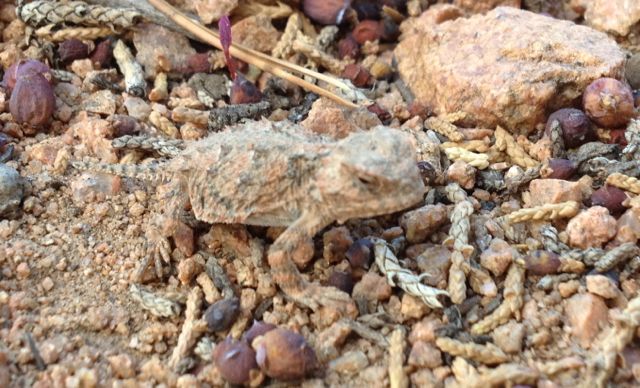 |
| Successful adaptation to a harsh climate: a baby horned toad. |
Adaptive water management needs to "get the ethics right" as an integral part of the adaptive process. The ethics that got us into the water crisis are not the right ethics to get us out, particularly as climate change exacerbates the crisis.
August 3, 2012
Gutsy
Bold statement on Indigenous access
to water resources barely causes a ripple
My water-nerd friend called it “gutsy”.
Last month, Australia's National
Water Commission (NWC) released this
statement calling for water allocation plans to include reserves
of water for Indigenous economic development.
The NWC's “Position Statement:
Indigenous Access to Water Resources” reflects policy from the
advisory group, First
People's Water Engagement Council. The statement describes
actions needed to improve Indigenous access to water in several
areas: water for culture, water for economic development, leadership
and governance, water planning/ management and drinking water
security in remote communities.
July 27, 2012
Relationships of convenience
In Australia tap water
is generally safe and seemingly abundant. This convenience comes
with a small price: the impact on our attitudes to water. Although
identifying our own biases is difficult, I've tried to expose a few
of my underlying assumptions. To help, I looked at my reactions to
different drinking water supplies. Welcome to
my mini-diary of drinking water baggage!
The Bosque in the 'Burbs
What draws so many people to the Rio Grande Nature Center (RGNC)? To find out, I spoke with Karen Herzenberg, RGNC's Instructional co-ordinator and Interpretive Naturalist. In this excerpt she describes two unintentional interpretive features at RGNC. Sorry about the poor audio quality.
Albuquerque's RGNC attracts an impressive number of visitors; 130,000 per year. A team of 170 volunteers commit to at least 24 hours of training before running a stack of activities, walks and talks. Every year 12,000 children attend a class at the center. It's not just locals taking advantage of a natural area so close to the city. Herzenberg tells me that visitors from “all over” come to see the waterbirds, “We're know internationally as a destination for birdwatchers... [who come for] specific birds you might only see in this area.”
In spite of it's high public value, I'm surprised that the cottonwood forest, or bosque, at RGNC still exists. Levees and irrigation ditches have dramatically reduced flow throughout the Rio Grande. The last flood was in 1941. Without floods, cottonwoods can't germinate and grow. Today, the aging stands of trees are slowly dying off. Reforestation is hampered by low water levels. Consequently, the bosque and wetland areas at RGNC contain some of the few remnants of the endemic ecosystems.
Albuquerque's RGNC attracts an impressive number of visitors; 130,000 per year. A team of 170 volunteers commit to at least 24 hours of training before running a stack of activities, walks and talks. Every year 12,000 children attend a class at the center. It's not just locals taking advantage of a natural area so close to the city. Herzenberg tells me that visitors from “all over” come to see the waterbirds, “We're know internationally as a destination for birdwatchers... [who come for] specific birds you might only see in this area.”
In spite of it's high public value, I'm surprised that the cottonwood forest, or bosque, at RGNC still exists. Levees and irrigation ditches have dramatically reduced flow throughout the Rio Grande. The last flood was in 1941. Without floods, cottonwoods can't germinate and grow. Today, the aging stands of trees are slowly dying off. Reforestation is hampered by low water levels. Consequently, the bosque and wetland areas at RGNC contain some of the few remnants of the endemic ecosystems.
Subscribe to:
Posts (Atom)