January 16, 2014

A Vehicle for Water Ethics


Two years ago I was working on my master’s degree, concentrating on water and its relation to sustainability. I was not quite sure of how to put my ideas together into a practical and meaningful application. As I was doing research for a paper on water privatization, I came across a small book by Robert William Sandford and Merrell-Ann S. Phare called Ethical Water: Learning to Value What Matters Most. This book, while small in size was big on content and became the basis for the rest of my academic career and the inspiration for my self-designed degree. All of my thinking about water seemed to suddenly find its focus.

The issue with water went beyond the disproportionate amounts that people had access to and the shortages and lack of sanitation that were occurring around the world. The real problem seemed to be in how easily water was ignored by most people unless there was some issue relating to either its lack or abundance. It was not appreciated for its value in everything including not just health and sanitation, but manufacturing, transportation, energy, and literally every aspect of our lives. Without water there would be no life as we know it on earth.

As the importance of all this took hold of me, I also questioned how I could pass on this vital understanding to others. I knew this would be difficult for any one person to do and I wondered how much impact I could realistically have. My idea was to try and pass these lessons on to children, the water stewards of tomorrow. I carried this notion forward into my thesis, “Water Ethics in Elementary Education.” I discovered there were no easy answers, as is so often the case in life. My research exposed as many new questions as answers, but it did not reduce my resolve or the importance of the message. I am still looking for a meaningful outlet to help people understand the significance of water in every aspect of our lives. I hope by reading my thesis, you will begin to understand some of the challenges in teaching our children about the ethics of water as well as the importance to do so.

Nancy Wells, Self-Designed MA in Water Ethics & Sustainability (*)

(*) The author's work (MA thesis) can be downloaded here.  Usual copyrights apply, please contact the author for further information.


December 23, 2013

Vernacular Efficiency

Do you know what ‘Vernacular Arts’ is? Until recently I didn’t either. But then I visited a startling exhibition about traditional societies’ housing architectures from all around the world.

A couple of things struck me.  First, vernacular is highly diverse and beautiful.  Today a modern tower looks pretty much the same anywhere on earth – a concrete glass and steel rectangle. Second, vernacular entails a highly efficient energy footprint before and after construction.  In fact, building components are made out of locally available materials with natural heating and cooling properties. Hence, it is argued that only 1% (!) of the modern total building costs are needed to erect and maintain ancient vernacular structures.

Water-wise, most of the models exposed had useful rainwater harvesting features. For instance, rooftops in Central Africa were meant to collect rainwater during the rainy seasons.  In Indonesia, traditionnal houses similar to “pagodas” had self-lifting tsunami-proofed rooftops sheltering from heavy rains. Today, most rooftops in urban areas are covered with cooling units, water tanks or satellite dishes making it difficult to install rain pipes and water treatment units. On the other hand, cement and plastic have become a universal quick-fix relinquishing wood and straw to cooking and heating fuel. 

Although, much more research needs to be done in the face of extreme weather events (typhoons, earthquakes, flash floods etc.), it seems that vernacular engineering matches closely with sustainable development and pro-poor strategies. Its sustainable use and re-use of natural resources should inspire architects and planners around the world.  Also, traditional know-how should be studied more in depth before relying on conventional glass and steel. Surely asbestos does not enter in the list of vernacular construction materials…

RB 


(Vernacular housing models from L to R in Indonesia, Japan and Tunisia, courtesy of EPFL Lausanne, retrieved 23.12.2013)

April 9, 2013

Water Guides, Rules or Regulations?

In Australia's arid heartland, a water conservation revolution is under-way. Last November I spoke with Liz Locksley, Alice Water Smart (AWS) Homes and Business Program Manager, about the Alice Water Smart Guide, at that time called the “Community Water Rules”.

December 30, 2012

Water Ethics for Climate Adaptation

It's unfortunate that the COP 18 meetings on climate change held in Doha, Qatar last month gave so little attention to water, much less to water ethics.  Water and climate impacts and adaptation strategies had been discussed in detail at a workshop in Mexico City in July, resulting in a very useful report.  But the much anticipated COP 18 meetings would have been an opportunity for exploring how water strategies, including the ethics underlying those strategies, could make a difference.

Statements from water experts participating in COP 18 focused on the need for more funding to implement adaptation measures that were not specified, as if everyone already knows what needs to be done.  In her presentation GWP Executive Director, Ania Grobicki noted, "We have the knowledge.  We have the tools."  What is missing is funding.  The Water and Climate Coalition issued a position paper which highlighted the need for both more funding, and a higher profile for water issues in climate discussions generally.

Maybe the water community would get more respect, and more funding too, if they broadened their message to include water ethics.  The key to successful adaptation to more erratic water regimes is not simply more infrastructure or more effective governance, though both will be necessary.  A shift in values and ethics is also needed to avoid the technology treadmill that I see happening in the Southwestern United States, where I live.  Without an ethic recognizing the rights of nature, we apply our engineering technology to transfer water from our rivers to our cities, farms, and factories, leaving the rivers dry and their ecosystems nearly dead.  Fear of climate change only enhances the incentives to remove every last drop from nature to meet the incessant human demand.

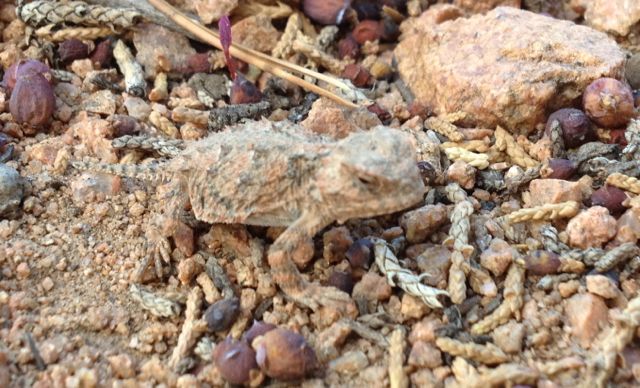
Successful adaptation to a harsh climate: a baby horned toad.
The ethics underlying the European Water Framework Directive, by contrast, recognizes the needs (and indirectly, the "rights") of rivers to flow, in order to support their dependent ecosystems, as well as future generations of dependent people. 

Adaptive water management needs to "get the ethics right" as an integral part of the adaptive process.  The ethics that got us into the water crisis are not the right ethics to get us out, particularly as climate change exacerbates the crisis.

August 3, 2012

Gutsy


Bold statement on Indigenous access to water resources barely causes a ripple

My water-nerd friend called it “gutsy”. Last month, Australia's National Water Commission (NWC) released this statement calling for water allocation plans to include reserves of water for Indigenous economic development.

The NWC's “Position Statement: Indigenous Access to Water Resources” reflects policy from the advisory group, First People's Water Engagement Council. The statement describes actions needed to improve Indigenous access to water in several areas: water for culture, water for economic development, leadership and governance, water planning/ management and drinking water security in remote communities.